

Pythagoras and Epicurus

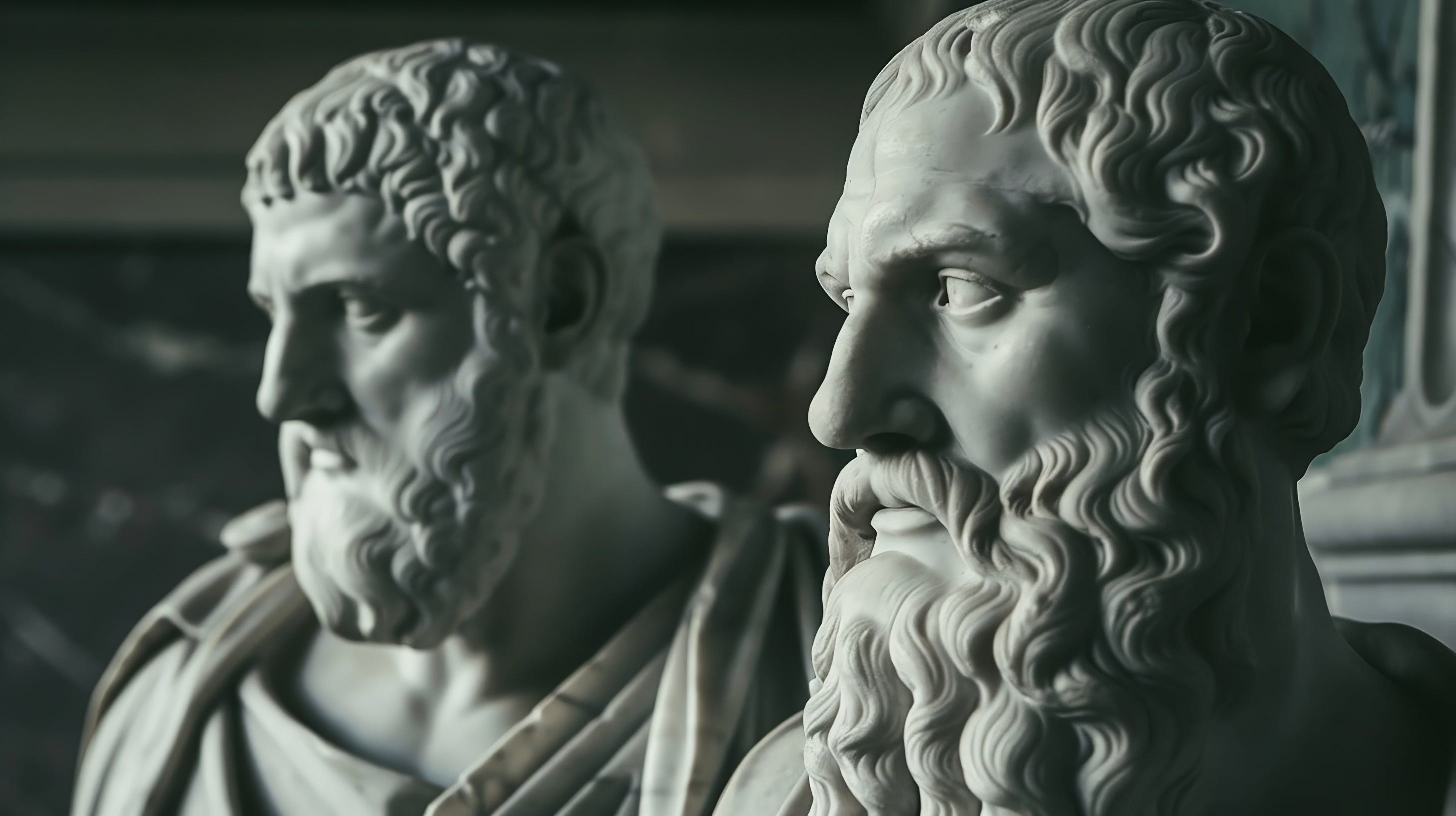
Growing up in Samos, Epicurus would have heard stories about the island’s most famous ever inhabitant, Pythagoras. There’s no way that Epicurus could not have been aware of him. They were connected by place, separated by time.
Both Pythagoras and Epicurus were born in Samos but not of Samian parents. Both would leave Samos to travel extensively throughout the known world seeking knowledge. Both would found philosophical schools which were also personality cults on properties donated by followers. Both were regarded as semi-perfect and godlike to their followers. Both would reject luxury in favor of simple pleasures and plain diets.
The parallels can’t be totally coincidental. Epicurus had to have consciously understood himself in the context of Pythagoras’s example. How could he not? Pythagoras was the first person ever in history to call himself a “philosopher.”
But the differences between these two men matter just as much, and maybe more. Pythagoras was mystical, esoteric. He combined the study of mathematics with occult practices and strange proscriptions on ordinary things. He had a passionate disgust for beans– all kinds of beans. Why? He thought there was something wicked about the fact that they give you gas. Yes, really!
He was also far stricter than Epicurus and demanded a test of loyalty before initiates could be welcomed into the fold. Would-be followers were told they would have to assume a vow of silence for a minimum of two but up to five years. During this time, they were not allowed to speak a word and were only permitted to hear the words of Pythagoras, who spoke to them from behind a screen. Try to appreciate the level of psychological manipulation involved in this. These people retreated entirely from the world during these years listening only to the voice of Pythagoras. The purpose of this exercise was reportedly to clear the voices from an unquiet mind. But it also conveniently served to clear the mind of everything not put there by Pythagoras.
There’s no evidence of Epicurus making any kind of demands on his followers. He also advised them not to hold their property in common, the way that the Pythagoreans did. This was because he recognized that, in spite of Pythagoras’s claims, this doesn’t make people more comfortable with each other. Really, the opposite is true. Resentments grow between members who can never assert anything as their own.
But more troubling is the way that people who have been stripped of their property can be manipulated by the cult’s leaders. Giving over everything to the cult gives the organization incredible leverage over the individual, which Epicurus must have seen was best avoided.
Also, while Epicurus was hailed as semi-divine by his followers, Pythagoras actively cultivated this image by spinning tall tales about his mystical powers. Once, he disappeared into a chamber in the earth and reemerged, skeletally thin, claiming that he’d been in Hades talking with the spirits of the dead. Epicurus never claimed to have any divine contact. Everything he taught could be learned by anyone without the need for any mystical world beyond our senses. He was regarded as “like a God” but only because he was as tranquil and satisfied as the gods in Epicurus’s conception were. Not because he was in any way magical or divine.
The way that the two men died says a lot, too. While Epicurus’s death was far from pleasant, at least while he was suffering from kidney stones he was surrounded by friends. Just like everything else about Pythagoras, there are many conflicting accounts of how he died. But while the stories don’t really fit together, what is clear is that Pythagoras didn’t go peacefully.
In one version, he was meeting with friends when a jealous rival set the house on fire. Pythagoras and friends escaped the blaze unscathed. But as he was trying to flee Pythagoras was blocked by a bean field. Well, we already know how he felt about beans. So, he stood there and allowed himself to be cut down by assassins rather than sully his feet in the bean field.
I’d love to believe in a universe in which deaths are this ironic, but frankly I don’t. This probably apocryphal story feels much less plausible than an alternate account in which Pythagoras passively killed himself through slow starvation.
But whatever actually happened, what is clear is that Pythagoras made enemies that made his control over his community at Kroton untenable. In some accounts, Pythagoras was killed because it was feared that he might become a tyrant.
Epicurus, who never sought political control over any city, never had this problem.
Well, actually his life was threatened by a mob once on Lampsacus but that’s another story.
So, what did Epicurus think of Pythagoras? If we look at the lives of the two men, we see a lot in common. If we look at their ideas, it’s clear that Epicurus was more interested in refuting Pythagoras than imitating him.
Pythagoras believed, and was maybe the first Greek ever to believe, in the transmigration of the soul after death. Epicurus believed in a soul made of atoms that disincorporated after death. Pythagoras argued that there was a mystical world unseen and inaccessible through the senses but which could be glimpsed through the study of music and mathematics. Epicurus probably studied mathematics but didn’t make it a core part of his teachings or beliefs.
Most importantly, there’s no evidence that Epicurus was ever a charlatan. The record is incomplete, of course. And there’s a lot about both men that we can’t know. But Epicurus never claimed to have any kind of divine wisdom or understanding. He treated his followers as friends and didn’t manipulate them into treating them with awe.
So what can we make of these two famous sons of Samos? They both left their island home to found philosophical schools. Both attracted devoted followers and taught about living well.
But while Pythagoras dealt in mystical revelations and divine powers, Epicurus just dealt in plain facts about the world we can all observe. Pythagoras demanded his followers surrender their property and suffer in silence. Epicurus invited his friends to dinner and talked things through. One man claimed he could speak with the dead. The other admitted he was just trying to figure things out like everyone else.
Maybe that's why Epicurus's ideas still feel relevant today, while Pythagoras's greatest legacy is a theorem about triangles - and some very strange ideas about beans.
Ειρήνη και Ασφάλεια
Peace and Safety