

The Introverted Epicurean
Reconciling Modern Personality Theory with Ancient Philosophy

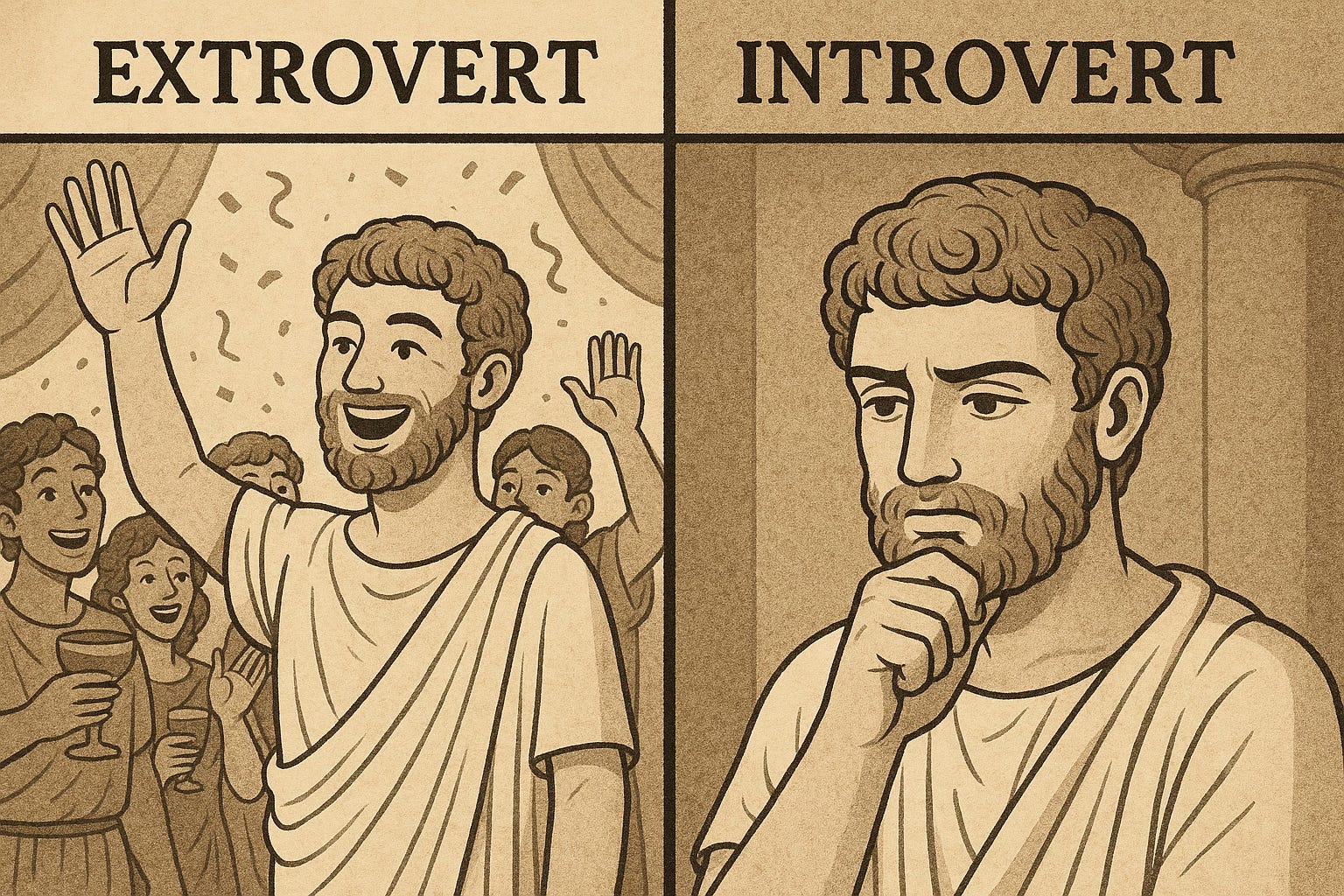
Earlier in the week, I talked about how Epicurus's Garden may have appealed to queer people and others who might have preferred not to have children for whatever reason. It got me thinking about the types of personalities who would have been drawn to the Garden. I'm naturally an introvert, which made me wonder whether I was being a good Epicurean.
After all, Epicurus founded a community where followers lived together, shared meals, and engaged in philosophical discussions. That sounds rather social, doesn't it? Would an introvert like me have thrived there, or would I have found myself exhausted by the constant company of others? This question led me down a rabbit hole of exploring how modern personality concepts might intersect with this ancient philosophy.
Introversion vs. Extroversion and also Ambiversion
Before we can address whether Epicureanism better suits introverts or extroverts, we need to understand what these terms actually mean. First popularized by Carl Jung (whose work on psychoanalysis I also explore in this essay) and later refined by numerous psychologists, the introversion-extroversion spectrum is one of the most enduring concepts in personality psychology.
At its core, the distinction relates to how individuals process stimulation and where they derive their energy. Extroverts tend to gain energy from social interaction and external stimulation. They often think while speaking, prefer breadth of relationships, and may feel restless or understimulated when alone for too long. The stereotypical extrovert is outgoing, talkative, and energized by parties and group activities.
Introverts, by contrast, expend energy during social interaction and recharge through solitude. They typically prefer to think before speaking, value depth over breadth in relationships, and may feel overwhelmed by excessive external stimulation. The stereotypical introvert enjoys quiet activities, close one-on-one conversations, and needs time alone to reflect and recuperate.
It's important to note that introversion is not synonymous with shyness or social anxiety, just as extroversion doesn't equate to confidence or social skill. An introvert may be perfectly comfortable in social situations but simply finds them draining rather than energizing. Similarly, an extrovert might struggle with social anxiety despite craving connection.
Most people exist somewhere along a spectrum rather than at the extreme ends. Many of us are "ambiverts" with both introverted and extroverted tendencies depending on context, mood, and other factors. Nevertheless, most people do tend to lean one way or the other in their general orientation toward social engagement.
With these modern concepts in mind, let's turn to Epicureanism and examine the evidence for both extroverted and introverted elements within this philosophy.
The Case for Epicurean Extroversion
On the surface, several aspects of Epicureanism seem to align with extroverted preferences. Most notably, Epicurus established his school, known as "The Garden," as a community where followers lived together rather than in isolation. Unlike the Cynics who often embraced a solitary existence or the Stoics who remained engaged in conventional society while maintaining inner detachment, Epicureans created their own social microcosm.
The Epicurean approach to knowledge was also inherently social. Learning occurred through conversation and dialogue rather than solitary study alone. Epicurus encouraged his followers to memorize his key doctrines and discuss them regularly with fellow community members. These discussions served both educational and therapeutic purposes, helping adherents overcome irrational fears and anxieties.
Even the Epicurean conception of pleasure—which they identified as the highest good—often had social dimensions. While they distinguished between necessary and unnecessary pleasures, the joy of meaningful conversation with friends was considered among the highest forms of pleasure. Epicurus himself reportedly said, "Before you eat or drink anything, consider carefully who you eat or drink with rather than what you eat or drink."
The emphasis on community extended beyond philosophical justifications to practical concerns as well. Living together provided economic efficiency, mutual security, and the ability to care for one another during illness or hardship. In a world without social safety nets, this communal support system offered considerable advantages over isolated living.
These aspects of Epicureanism suggest a philosophy that values social connection, community support, and shared experience—elements that might particularly appeal to those with extroverted tendencies.
The Case for Epicurean Introversion
Despite these communal aspects, Epicureanism contains numerous elements that would resonate deeply with introverts. Perhaps most famously, Epicurus suggested that it's best to “live unknown,” not seeking renown or public status. Unlike philosophers who emphasized civic duty or public service, Epicurus advised his followers to avoid the stress, competition, and external validation of public affairs.
This withdrawal wasn't motivated by misanthropy but by a calculated assessment of what truly contributes to happiness. Epicurus observed that public life, with its endless striving for status, wealth, and power, often led to anxiety and suffering rather than tranquility. Seneca, incidentally, thought the same though it didn’t stop him from entering the fray of public life anyway. By stepping back from these pursuits, Epicureans could focus on what truly mattered: simple pleasures, meaningful relationships, and peace of mind.
The Epicurean community was notably selective and intimate. Unlike the bustling marketplaces where Socrates engaged in dialogue with anyone willing to participate, the Garden was a relatively closed community of like-minded individuals. Epicurus valued quality of relationships, writing that "The noble soul occupies itself with wisdom and friendship; of these, the one is a mortal good, the other immortal."
Central to Epicurean philosophy was the concept of autarkeia (self-sufficiency)—the ability to be content with one's own resources and inner state rather than depending on external validation or stimulation. This emphasis on self-reliance and inner contentment aligns well with introverted tendencies toward self-reflection and internal processing.
Even the Epicurean approach to pleasure reflects aspects of introversion. While they recognized pleasure as the highest good, they defined it primarily as the absence of pain (aponia) and disturbance (ataraxia) rather than intense stimulation. Simple pleasures—like quiet conversation with friends, contemplation of nature, or enjoying modest meals—were valued over extravagant feasts or lavish entertainments that might overwhelm the senses.
The therapeutic practices of Epicureanism often involved introspection and contemplation. Followers were encouraged to examine their desires, distinguish between necessary and unnecessary wants, and reflect on the true sources of anxiety. These practices required the kind of thoughtful self-examination that introverts often excel at.
Reconciling the Apparent Contradiction
How do we reconcile these seemingly contradictory aspects of Epicureanism? The key lies in understanding that Epicurus wasn't prescribing either complete solitude or constant socialization, but rather a mindful middle path centered on what truly contributes to lasting happiness.
Epicurean friendship represents what we might call "selective sociality"—a deliberate approach to social connection that prioritizes depth and quality over breadth and quantity. In modern terms, it's neither the life of a hermit nor that of a social butterfly, but something more intentional and balanced.
This selective approach manifests in several ways. First, the Garden community was relatively small compared to other social institutions of its time. Rather than seeking to expand indefinitely, it maintained a size conducive to genuine connection. Second, membership was selective, focusing on compatibility of values and philosophical outlook rather than status or background. Third, the community established its own norms and boundaries, creating a space where members could engage authentically without the performance often required in mainstream society.
The distinction between Epicurean community and modern concepts of networking is particularly important. While today's extrovert-oriented culture often values extensive connections and constant engagement (think of social media and professional networking), the Epicurean approach was far more contained and purposeful. Relationships weren't instrumental but intrinsically valuable, focused on mutual support and philosophical growth rather than status or advantage.
Perhaps most importantly, Epicureanism embedded a profound respect for individual differences within its communal framework. While advocating for friendship and community, it simultaneously valued personal autonomy and self-sufficiency. This balance between connection and independence created space for different social preferences and needs, allowing for both engagement and withdrawal as appropriate.
In this light, we might view Epicureanism not as inherently favoring either introversion or extroversion, but as offering wisdom to both: reminding extroverts of the value of moderation and self-sufficiency, while encouraging introverts to recognize the necessary role of friendship in the good life.
Epicureanism for Modern Introverts
As an introvert drawn to Epicurean philosophy, I find particular resonance in certain aspects that seem especially compatible with introverted preferences. The Epicurean garden offers a model for social engagement that many introverts might find appealing: a small, stable community of like-minded individuals with shared values and interests, where meaningful conversation takes precedence over small talk or social performance.
The principle of "living hidden" provides philosophical justification for the introvert's natural inclination toward a quieter, less public-facing life. In a culture that often celebrates visibility and self-promotion, Epicurus reminds us that happiness rarely comes from external validation or public acclaim. There's wisdom in choosing a path that honors our need for tranquility over status.
Epicurean practices around desire management and mental tranquility align well with introverted tendencies toward reflection and internal processing. The regular examination of one's thoughts and desires, distinguishing between necessary and unnecessary wants, and practicing gratitude for simple pleasures—these are contemplative practices that introverts often excel at and enjoy.
For the modern introvert seeking to adapt Epicurean community ideals, several approaches seem promising:
First, focus on cultivating a small circle of deep friendships rather than an extensive network of acquaintances. Quality over quantity remains as valid a principle today as it was in Epicurus's time. These connections might be maintained through regular, meaningful conversations rather than constant contact or large gatherings.
Second, create intentional spaces for both connection and solitude. Just as the Garden was a sanctuary from the bustle of Athenian life, modern introverts benefit from establishing boundaries that protect their energy while still allowing for meaningful engagement. This might involve scheduling social activities thoughtfully, with built-in time for recovery afterward.
Third, embrace technological connection when it serves genuine friendship but resist the pressure for constant digital availability. Epicurus would likely view much of social media as an unnecessary desire leading to more disturbance than pleasure. Selective engagement that prioritizes depth over breadth aligns well with both Epicurean principles and introverted preferences.
Finally, recognize that self-sufficiency doesn't mean complete self-reliance. Even the most introverted among us benefit from mutual support and meaningful connection. The Epicurean model reminds us that independence and interdependence can coexist—we can value our solitude while also recognizing the irreplaceable role of friendship in a well-lived life.
Conclusion
So am I being a "good Epicurean" as an introvert? I believe Epicurus himself would say yes—provided I don't use introversion as an excuse for complete withdrawal, but rather cultivate those few, meaningful friendships that nourish the soul while honoring my need for reflection and tranquility. The philosophy of the Garden has room for both those who gain energy from social engagement and those who find renewal in solitude, united by a common pursuit of the truly pleasant life.
In that pursuit, perhaps introverts and extroverts have more to learn from each other than either might initially suspect—a collaboration that Epicurus, with his emphasis on both friendship and individual flourishing, would surely approve.
Ειρήνη και Ασφάλεια
Peace and Safety